
10 November 2026 · 16 min read
Psychological safety at work: how to tell your team has gone quiet
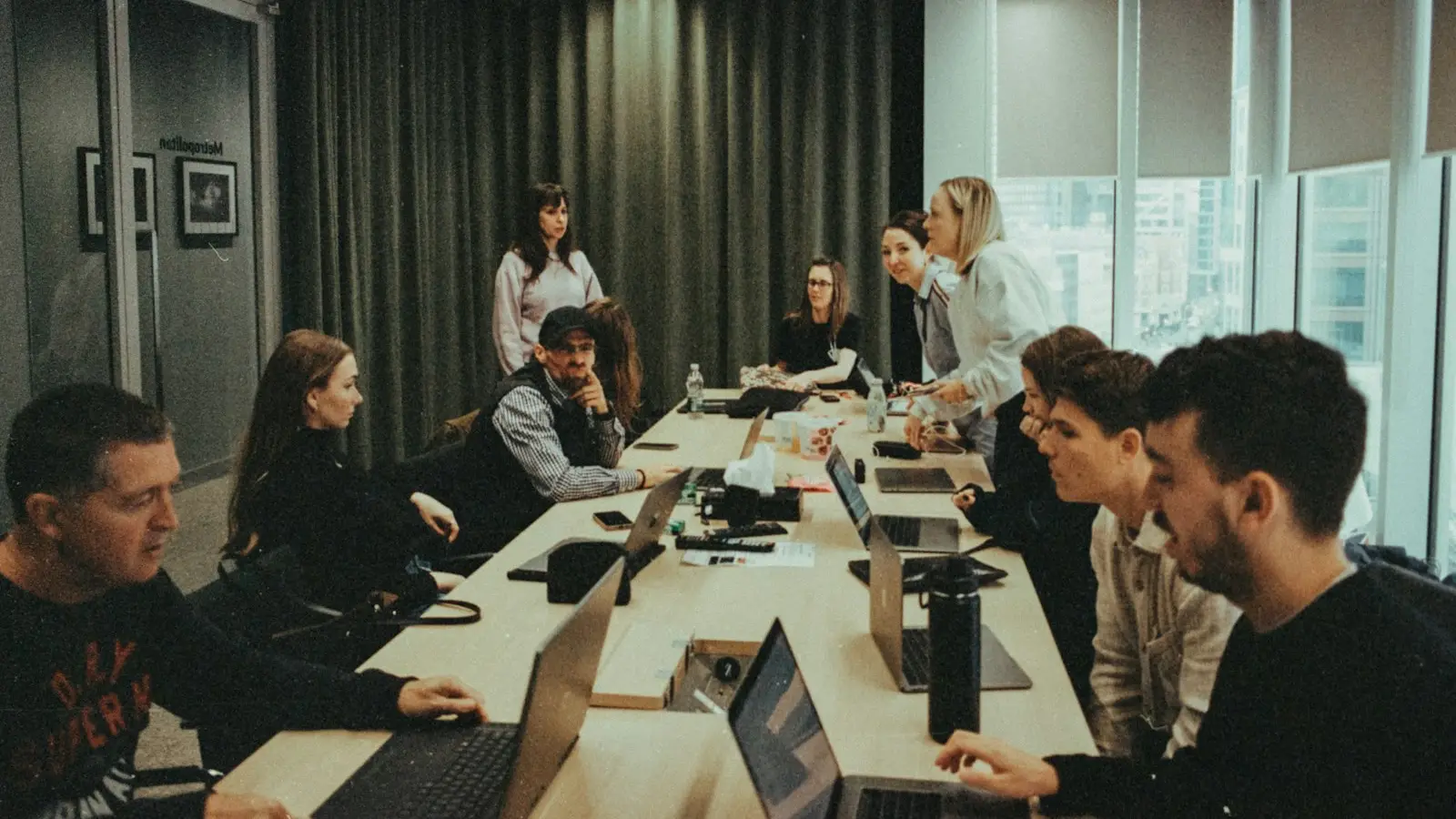
A quiet meeting feels like agreement. Often it is a team working out what it costs to disagree, and deciding the price is too high.
The four seconds after "Any questions?"
Hannah runs a team of nine. On Monday she puts the quarter's plan on the screen: the launch has moved forward two weeks, because a large client asked. She walks through it and then says, "Any questions?"
Four seconds. A chair creaks. "Great," she says, "sounds like we're aligned," and the meeting ends early, which feels like a good sign.
At four minutes past eleven Jamie messages Sol: "that date is not happening." Sol replies with one emoji. Neither of them says it to Hannah. Jamie questioned a date once before, in a meeting last spring, and remembers the pause before the answer and the phrase "let's take that offline", which nobody ever did.
Three weeks later the launch slips. In the review somebody says, mildly, "We all thought it was tight." Hannah asks the question every manager in her chair asks sooner or later: then why did nobody say?
The honest answer is that somebody did. They said it to each other.
What is psychological safety at work?
Psychological safety is the name for what was missing from those four seconds. Amy Edmondson defined team psychological safety as "a shared belief held by members of a team that the team is safe for interpersonal risk taking" (Amy Edmondson, Administrative Science Quarterly, 1999).
Three parts of that sentence do most of the work.
Shared. It belongs to the team, not to its bravest member. A team can contain one person who will say anything and still be a quiet team, because one voice is easy to file under "that's just how she is".
Belief. It is a prediction about what will happen next, built from what happened last time. That is why Jamie's memory of one meeting last spring outweighed Hannah's invitation this Monday. An invitation is a promise, and a memory is evidence.
Interpersonal risk. The risk is rarely formal and never physical. It is looking slow, wrong or awkward in front of the people whose opinion decides your next project.
So at work the useful question is not "do people feel good here?" It is "what does it cost to say the true thing in this room, and who has already worked out the price?"
Silence is data: how many people stay quiet at work
Most managers read a quiet meeting as consent. A recent UK figure suggests reading it as a question instead.
45% of UK employees feel unable to raise a mistake or a risk at work, and 15% say they have made a preventable mistake because they felt unsafe speaking up (Mental Health First Aid England, The cost of workplace silence, February 2026). The survey spoke to 2,000 UK working adults, and our news story on it has the detail.
Look at the verb. Not "chose not to", but "feel unable". A raised risk is exactly what Jamie had, and it is the kind of thing a large share of people say they cannot bring up. A manager who waits for risks to be volunteered is waiting on the people who feel able, and hearing from nobody else.
So silence is not an absence of information. It is information about the room. It just is not the information "we agree".
Signs of a lack of psychological safety in the workplace
You will rarely see it in a score first. You will see it in where the talking happens.
- "Any questions?" gets none, and the questions arrive later. One-to-one, in the corridor, in a private chat, after the decision they could have changed.
- Bad news arrives finished. A problem is reported with its fix already attached, or after the deadline it affected, because bringing it half-understood felt like admitting you had lost control of it.
- Updates stay green until the day they turn red. Nothing is "at risk" for weeks, then several things are late at once.
- The basic question never gets asked. An acronym goes round the table unexplained, and the newest person in the room nods along with everyone else.
- Agreement is quick and the follow-through is slow. A decision passes without a single "what if", then gets carried out half-heartedly by people who were never convinced and never said so.
Any one of these has an innocent explanation. Three of them in the same month usually do not.
Where a quiet team costs you
The silence rarely shows up under its own name. It shows up as something else, and each of these has a piece of its own:
- Mistakes go quiet. People hide an error once they have watched what happened to the last person who owned one. That is a blame culture.
- Small lapses go unchallenged. A figure gets massaged, a corner gets cut, and the room says nothing because nobody wants to be first. That is the bystander side of workplace ethics.
- Nobody believes the updates. When the honest version only travels in private, the official one stops being trusted. That is a lack of trust.
- Disagreement goes underground. A difference about the work that cannot be said in the meeting gets said about the person afterwards. That is conflict that has turned personal.
Under all four sits the same question: what it costs to say the true thing out loud. Treat one of them without touching that, and the other three carry on.
What psychological safety is not
The phrase has picked up a reputation it did not earn: a team where nobody is challenged, nobody is upset and standards quietly slide. Edmondson ruled that out in the paper that defined the term.
Edmondson wrote that team psychological safety is not the same as group cohesiveness, which research has shown can reduce willingness to disagree, and that the term suggests neither a careless sense of permissiveness nor an unrelentingly positive affect, but a sense of confidence that the team will not embarrass, reject, or punish someone for speaking up (Amy Edmondson, Administrative Science Quarterly, 1999).
That gives three things it is not.
- Not niceness. A close, friendly team can be the quietest in the building, because nobody wants to be the one who spoils it. Hannah's team gets on well. That is part of why nobody said anything.
- Not low standards. Safety is about what happens to the person who speaks, not about what counts as good work. A team can expect a great deal and still make it cheap to say "I'm behind".
- Not a permanently good mood. A safe team argues. The arguments are about the work, out loud, in the meeting, rather than about each other, afterwards. A value like Respect only helps here when the team can say what it looks like in the room, which is the test Company values examples you could catch someone doing puts to every value.
Psychological safety examples: what it sounds like on a Tuesday
Edmondson's paper is useful here too, because it names what safety is for. Edmondson gave as examples of learning behaviour in a team seeking feedback, sharing information, asking for help, talking about errors, and experimenting, and wrote that by admitting an error or asking for help, an individual may appear incompetent and thus suffer a blow to their image (Amy Edmondson, Administrative Science Quarterly, 1999).
That second half is the whole problem in one clause. Every useful thing a team member can say carries a small chance of looking bad. Where it is safe, those things are ordinary sentences, said in the meeting:
- Asking for help: "Sorry, what does that stand for?"
- Seeking feedback: "Can someone look at this before I finish it? I'm stuck on the pricing."
- Sharing information: "I think the date is wrong, and here's why."
- Talking about errors: "The figure I sent on Friday was last month's. Corrected version attached."
- Experimenting: "Could we try it with one client first and see?"
Where it is missing, every one of those sentences still gets thought. It is said to one colleague, or to nobody. The difference between a safe team and a quiet one is not what people think. It is where the thought lands.
Why psychological safety matters: what the research links it to
The 1999 paper did not stop at a definition. In a study of 51 work teams in a manufacturing company, team psychological safety was associated with learning behaviour, and learning behaviour mediated between team psychological safety and team performance (Amy Edmondson, Administrative Science Quarterly, 1999).
In plain words: the teams that felt safer did more of the asking, checking and admitting in the list above, and the link to how well they performed ran through that behaviour. Safety on its own does not do the work. It is what makes the useful behaviour affordable.
The wider evidence points the same way. Across 136 independent samples covering more than 22,000 people, psychological safety is linked with how well people perform their tasks (Frazier, Fainshmidt, Klinger, Pezeshkan and Vracheva, Personnel Psychology, 2017).
Hold both findings at the right distance. The first is one company. The second pools many studies and shows a link, which cannot by itself say which way it runs: a team that is doing well may simply find it easier to speak. What neither says is that a team becomes safe by being told it is.
When the quiet room is full of experts
Seniority does not buy a voice. About three in four of the senior doctors who took part in an independent listening exercise at Addenbrooke's described fear of speaking up, of what follows, or doubt that anything would change (Transformation Partners in Health and Care, Medical voice: listening with purpose, July 2026). Fewer than one in five of the consultants and SAS doctors took part, so this speaks for the people who chose to, and our news story has the detail.
These are among the most qualified people in any organisation, and expertise did not make the room safe for them. Look at the last item on the list: doubt that anything would change. That is not fear. It is a judgement, made from evidence, that speaking up is a waste of breath.
A team can be entirely unafraid of its manager and still be silent, because it has watched the last three concerns disappear into "let's take that offline". Jamie was not scared of Hannah. Jamie had done the arithmetic.
How to build psychological safety: five low-risk ways to reopen a quiet team
None of this needs a budget. Each one lowers the price of speaking for the next person, which is the lever a manager holds most directly.
Swap "Any questions?" for a question that assumes there are some
"Any questions?" has a right answer, and it is no. Ask "Where does this go wrong first?" or "What's the weakest part of this plan?", then wait longer than feels comfortable. Count to ten in your head. The first answer will be small. Treat it as if it were large.
Collect the first round before anyone speaks
Before a decision, give everyone two minutes to write down one concern, in the chat or on paper, then read them all out together. Nobody has to go first, nothing has been said yet for anyone to fall in behind, and the quietest person's concern sits on the screen beside everybody else's.
Speak last in your own meeting
Once the manager has given a view, everyone else is answering it. Hold yours until the room has spoken, even when you are sure. Especially when you are sure. If the team has a team charter, this is a line worth putting in it, with a behaviour beside it that anyone could check.
Say what happened to the last thing somebody raised
Doubt that anything will change is answered with news, not reassurance. At the start of the next meeting, report back on one concern raised in the last: what changed, or what did not and why, or when you will know. "Still looking at it, I'll say more on the 20th" is enough. Silence is not.
Ask the basic question yourself, out loud
Ask what the acronym stands for. Say "I don't follow, walk me through it." When the person with the most status pays the small price of looking slow, the price drops for everyone else.
What not to do
- Do not announce that this is a safe space. A declaration costs nothing, so it proves nothing. The team will wait to see what happens to the first person who takes you at your word.
- Do not go round the table demanding a view from the quietest person. Being put on the spot in front of the group is the very risk they were avoiding.
- Do not ask for views and then go quiet. A round of feedback that vanishes teaches "nothing will change" faster than no round at all.
- Do not mistake a pleasant meeting for a safe one. In the first few weeks, a good sign may be a meeting that is slightly less comfortable than it used to be.
Questions managers ask about psychological safety
Is psychological safety the same as being nice?
No: psychological safety is confidence that speaking up will not get you embarrassed, rejected or punished, and a very nice team can lack it. Edmondson separated it from cohesiveness because closeness can make people less willing to disagree. Niceness keeps the meeting pleasant. Safety is what lets someone say, in that pleasant meeting, that the date is wrong.
Can a quiet team still be a safe team?
Yes, because volume is not the sign. Some teams are quiet because the work is going well, or because they think before they talk. The test is whether the awkward things still arrive, and arrive early: the risk raised before the deadline, the basic question asked in the meeting, the mistake reported by the person who made it.
How do you measure psychological safety?
A manager reads psychological safety most cheaply by watching when bad news reaches them and where questions get asked. Research treats it as something a whole team holds, so it is read across the team rather than from one person. In your own week, count how many concerns surface in the meeting rather than after it, and whether problems arrive while they can still be fixed.
What if the silence starts above me?
Then change the room you run, because that is the one your team reads first. A team lead cannot rewrite how a director reacts to bad news, but can make their own meeting the place where the date gets questioned and the miss gets reported. Carry what the team says upward in its own words, and tell them what came back.
How MeaningFuel helps a quiet team
The daily insight: Courage, Trust and Feedback
A company chooses the values and skills it wants to work on, and each working day everyone gets one short insight on one of them. A quiet team is a problem, and a problem cannot be chosen for the daily culture: that is what a module is for. What a company can choose is what a quiet team is short of: Courage and Trust as values, and Feedback as a skill.
In an ordinary week that might put a line on saying the unwelcome thing in front of Jamie on Tuesday, and one on asking for criticism in front of Hannah on Thursday, on days when nothing is on fire. It will not make anyone speak up on Monday. It keeps the idea in the working week, so that "where does this go wrong first?" sounds like something this team talks about, not something its manager read about.
The module: Openness and Trust
Openness and Trust is the module for a team whose updates arrive polished or late and whose real questions have moved into private messages, which is Hannah's Monday in one sentence. It draws on research by Ron Westrum on how organisations handle information, and by Amy Edmondson on psychological safety. Booked for a team, it invites the team's named people, each of them chooses whether to take part, and those who join get one short lesson each working day for two working weeks.
One lesson is the naive question: the basic one everybody assumes everybody else can already answer. The move is to ask it where the whole team can see it, with no "sorry if this is dumb" in front, because the apology teaches the room that it might be. Another is the messenger test, which opens with an audit: what news are you sitting on until "a better moment"? The action is to send it now, labelled as early and incomplete, because early is what lets other people act.
The lead runs two ten-minute debriefs from a written guide. At the first, each person names something they disclosed recently and what came back, and the guide tells the lead to go last, with a real one: something it cost them to say.
The module names its own limit. Where what is in the way is one specific broken promise, it is the wrong tool, and a repair conversation is the right one. And where the silence is about mistakes, Learning from Mistakes is the closer course.
What Insights would and would not tell you
Insights shows how alive the habit is, by team and by theme, pooled, with nobody named. During a module the lead sees whether the team is doing it, never anyone's answers or what they write. On a quiet team that limit is the point: a lead who could read who said what would be handing the team one more reason to say nothing.
It will not tell Hannah who stayed quiet on Monday, or why. A team can take part every morning and still let the date go unchallenged.
What it does not do
It promises no outcome, and it does not replace what a manager does in the room, which is the thing the team is actually watching. What it does is put the asking and the reporting back on a schedule, so they do not depend on one manager remembering on a busy Monday. If the silence starts above the team, a module for the team will not reach it unless the people above are in it too.
Back to Monday
Next Monday Hannah puts the revised plan up and asks, "Where does this go wrong first?" Then she waits.
Eight seconds is a long time in a meeting. At about the eighth, Jamie says the testing window looks short. It is a small point, and a safe one: a toe in the water. Hannah says "thank you, show me", and the meeting runs ten minutes over, on the right subject.
The four seconds last Monday were never agreement. They were the team's estimate of the price.
The offsite worked. That was never the problem.
Week six is the problem. The person who ran it has moved teams, the thing everyone agreed has quietly stopped happening, and nobody can name the day it stopped.
MeaningFuel keeps it going: one short insight each working day on the values you chose, and a two-week micro-training for any team that falls behind. You see which teams carry them, pooled, with nobody named.
Already have an account? Sign in